Work today is changing fast. Filipino organizations are feeling this change every day.
New tools, evolving roles, tighter deadlines, and higher expectations now define the modern workplace. In this environment, learning and development have become essential for both performance and sustainability.
At People Dynamics Inc. (PDI), we see this shift firsthand. Drawing from a recent study that integrated data from multiple participating organizations, we examined how Filipino employees are developing and where they need the most support to succeed in today’s increasingly complex work environment. The analysis was informed by quantitative data drawn from our competency assessment references that allowed us to identify consistent patterns in capability development, workplace behaviors, and emerging areas for growth across organizations.
This article breaks down these insights in a clear, and best practical way, that explains what this means for organizations today.
What Makes the Filipino Workforce Strong
Filipino culture is one of the key foundations behind the strength and effectiveness of the Filipino workforce. Deeply rooted cultural values such as collaboration, resilience, and trust enable Filipino employees to work well in teams, remain steady during periods of uncertainty, and uphold reliability even under pressure. These traits have long made Filipino professionals valued contributors across industries and global markets.
However, as modern workplaces become increasingly complex and demanding, these inherent strengths must be continuously nurtured and reinforced through the development of new skills. While strong values provide stability and cohesion, they do not automatically translate into clarity, accountability, or decisive action—qualities that are essential in fast-paced, results-driven environments. To truly thrive amid evolving business challenges, Filipino workers need practical skills, structured frameworks, and a solid professional foundation that complement their cultural strengths and enable sustainable growth and high performance.
Core Strengths Observed Across Organizations
Filipino employees are known for being:
- Values-driven – Integrity and reliability show up consistently.
- Team-oriented – Collaboration and cooperation are natural strengths.
- Adaptable – Many employees adjust well to change when supported.
These qualities help teams stay steady, even during uncertainty or disruption. They also create a strong foundation of trust and teamwork in organizations.
Why Development Still Matters
Strong values play an important role in the workplace. However, today’s work environment is more complex than ever. Roles are more outcome-driven, highly interconnected, and fast-paced. Because of this, employees are expected to think, decide, and lead more independently.
The PDI study shows that common development needs are not signs of weakness. They reflect changing expectations at work. As responsibilities grow, employees need clearer communication, stronger accountability, and better decision-making skills to perform well.
Key Development Themes
Across participating organizations, the same areas surfaced again and again:
- Clear communication
- Accountability and ownership
- Higher-order thinking and decision-making
- Leadership readiness
- Productivity and work systems
To better understand why these development areas continue to surface, the study also looked at underlying work preferences and personality patterns; not to label individuals, but to provide context for how people approach work.
What the Data Reveals About Work Preferences
When competency data is viewed alongside personality patterns, another insight emerges. Many Filipino employees show a preference for:
- Stability
- Clear structure
- Cooperative work environments
These traits support teamwork and dependability. However, they also point to the need for intentional development in areas like:
- Assertiveness
- Proactive ownership
- Independent decision-making
These skills become especially important for leadership and critical roles.
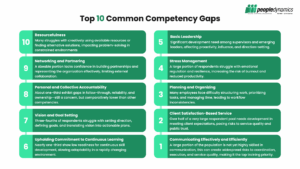
Top 10 Common Competency Gaps
When leaders hear the phrase “competency gaps,” it’s easy to think of deficiencies. But that’s not what the data shows.
Instead, these gaps reflect a workforce in transition—moving from relationship-driven work to outcome-driven work, from clear instructions to shared ownership, and from stability to continuous change.
10. Resourcefulness
Some struggle to:
- Find creative solutions
- Maximize available resources
This affects problem-solving, especially under constraints.
9. Networking and Partnering
Many employees lack confidence in:
- Building external relationships
- Representing their organization
This limits collaboration opportunities.
8. Personal and Collective Accountability
Some gaps still exist in:
- Follow-through
- Ownership
- Reliability
While lower than other areas, it remains important.
7. Vision and Goal Setting
Employees often struggle to:
- See the bigger picture
- Translate vision into goals
This affects alignment and execution.
6. Commitment to Continuous Learning
Nearly one-third show low readiness to:
- Upskill regularly
- Adapt to new demands
This slows growth in fast-changing environments.
5. Basic Leadership
Many supervisors and emerging leaders need help with:
- Setting direction
- Influencing others
- Taking initiative
Leadership readiness remains a key focus area.
4. Stress Management
A large number of employees find it hard to:
- Regulate emotions
- Manage pressure
- Recover from stress
Without support, this increases burnout risk.
3. Planning and Organizing
Common challenges include:
- Prioritizing tasks
- Managing time
- Structuring daily work
These issues often lead to workflow delays.
2. Client Satisfaction-Based Service
Over half of respondents need support in:
- Understanding client expectations
- Delivering consistent service
This gap can affect trust and service quality.
1. Communicating Effectively and Efficiently
Many employees struggle to:
- Set clear direction
- Define goals
- Turn ideas into action plans
Clear communication remains the top development need.
What This Means for Organizations
For Filipino organizations, these insights offer clarity. Many of the challenges leaders face today, misalignment, slow execution, leadership readiness, burnout; are not isolated problems. They are connected to shared development priorities across the workforce.
The strong alignment between these findings and commonly requested learning programs confirms one thing: data-backed development strategies matter.
The findings strongly align with what organizations are already asking for. Leadership, communication, critical thinking, and productivity programs consistently rank among the most requested learning interventions.
This alignment confirms: data-backed development strategies matter.
By designing learning programs around these shared priorities, organizations can:
- Build stronger leadership pipelines
- Improve accountability and execution
- Support employees in more demanding roles
- Strengthen long-term workforce resilience
A Balanced View of Growth
The study the PDI team conducted offers a grounded, respectful, and most importantly, realistic view of the Filipino workforce. It celebrates existing strengths while clearly acknowledging pointing toward future development needs.
When organizations base learning strategies on ethical, aggregated data, organizations are better positioned to design learning programs that build accountability, strengthen leadership pipelines, and enable employees to perform effectively in an increasingly demanding and dynamic work environment.
Turning Insights Into Action
In a workforce known for strong values and deep commitment, the opportunity is clear: when organizations intentionally develop the right skills, Filipino talent doesn’t just adapt—it leads.
People Dynamics Inc. (PDI) helps organizations close these gaps through learning programs grounded in real data and real workplace needs. Our development solutions are designed to strengthen communication, leadership, critical thinking, and productivity—areas consistently identified as top priorities across the Filipino workforce.
Whether you’re developing future leaders or strengthening everyday performance, PDI offers learning options that meet organizations where they are.
How You Can Get Started
- Join our Public Seminars (PubSem) to gain practical tools you can apply right away
- Partner with us for In-House Training tailored to your organization’s specific challenges
- Learn from programs built on actual competency data, not generic frameworks
By signing up here, you’ll receive early access to upcoming programs, exclusive learning resources, and invitations to PDI’s public seminars, helping you turn insight into impact, one capability at a time.